
Willow
the tree with unique capabilities.
From nursery to planting site, Ramo harnesses what willow does best: grow fast, drink deeply, and adapt anywhere. Four angles to understand why willow is at the heart of every Ramo project.
Willow, in brief
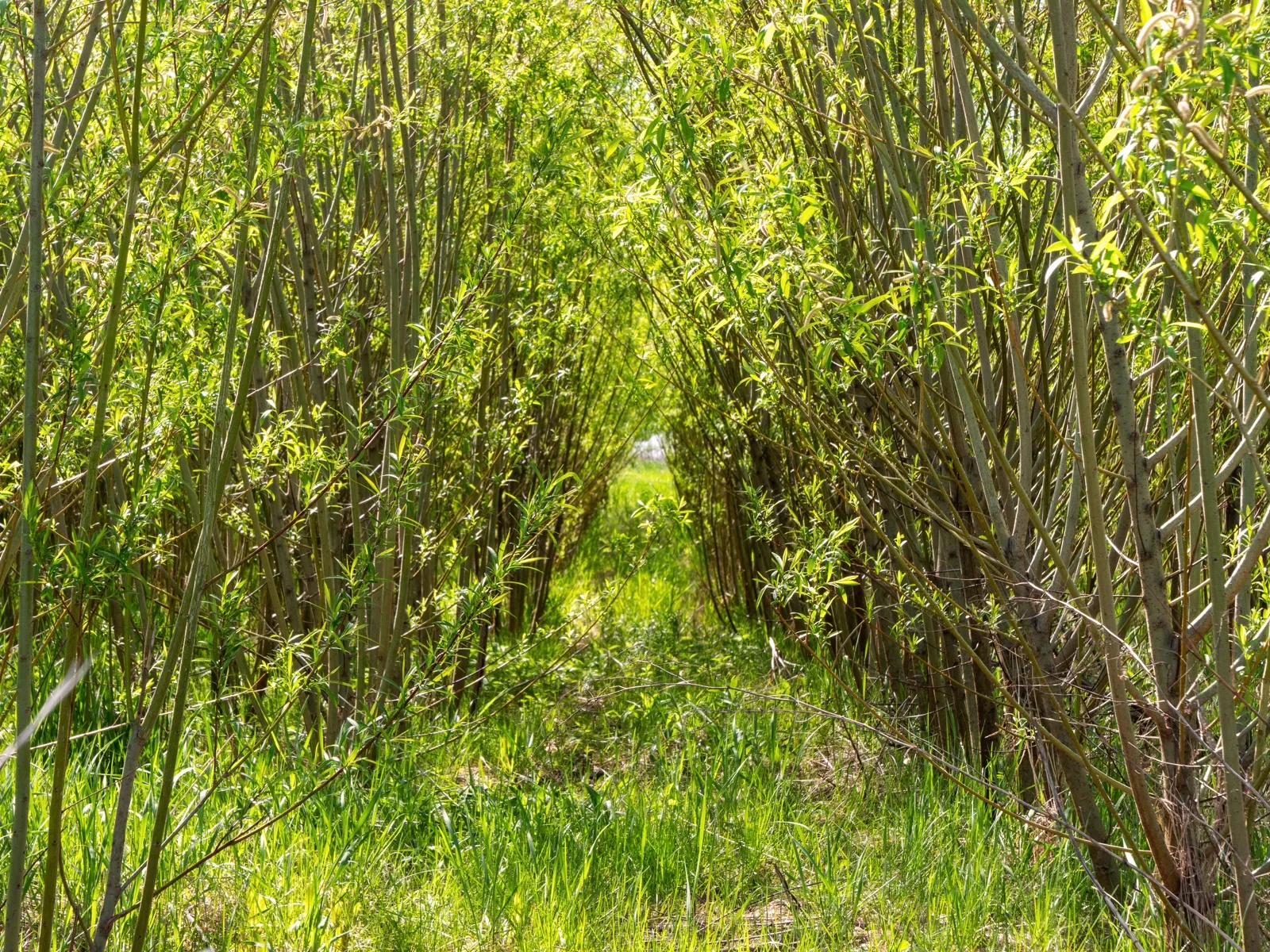
Willow, genus Salix, is a fast-growing tree or shrub found naturally in wetlands across the Northern Hemisphere. Quebec alone has dozens of native species. Ramo grows nearly 70 varieties, selected for their vigour, their dense root system and their ability to take up large volumes of water.
- Growth: up to 4 m per year in dense plantings, regrowing from the stump after every cut.
- Water: up to 4,508 m³ of water evapotranspired per hectare per year, the basis of plant-based water treatment.
- Carbon: up to 32 t of CO₂ equivalent sequestered per hectare per year.
- Cycle: propagated from cuttings, harvested every three years, with a planting that stays productive for 20 to 30 years.
These properties are used to treat wastewater and leachate, to reduce stormwater runoff, to revegetate degraded sites, to build noise barriers and woven willow fences, to produce RCW and to supply cuttings and rods.
Four angles to explore willow.
Willow at the heart of Ramo solutions
Why Ramo made willow the foundation of all its environmental solutions.
Read the article →Nearly 70 varieties grown in Canada
Salix viminalis, miyabeana, dasyclados and their hybrids: why Ramo grows so many species and how each one finds its place (from northern climates to industrial soils).
Read the article →Willow cultivation, step by step
Cutting propagation, high-density planting, coppicing every 3 years, harvest, valorization: the complete cycle of a Ramo planting, over 20 to 30 years.
Read the article →RCW, ramial chipped wood: regenerating depleted soil
Ramial chipped wood: restoration of degraded soils, revegetation substrates, professional mulch. The science behind the RCW effect, its B2B applications and why willow is the strategic raw material.
Read the article →Willow, your questions.
What is a willow?
Willow is a tree or shrub of the genus Salix, in the Salicaceae family alongside poplar. It grows naturally along watercourses and in moist soils. There are more than 300 species worldwide and dozens in Quebec, from the tall black willow to the shrubby willows that form coppices.
Is willow a tree or a shrub?
Both exist. Some species grow into large trees, such as the weeping willow or the black willow. Others, such as Salix viminalis or Salix miyabeana, remain multi-stemmed shrubs. Ramo mainly grows these shrub willows as short-rotation coppice, because they grow fast and regrow from the stump after each harvest.
How fast does a willow grow?
In a dense planting with a good water supply, a shrub willow can gain up to 4 m in a single season. After a cut, the stump sends up new stems the following spring. It is one of the fastest-growing woody plants in Quebec, which is why willow is used to revegetate degraded sites quickly.
Why is willow used to treat water?
Because it drinks a lot. A willow planting can evapotranspire up to 4,508 m³ of water per hectare per year, and its dense root system tolerates wet soils and nutrient-rich water. That is the principle behind Evaplant®, which manages leachate and wastewater with zero liquid discharge, and Evacap™, which reduces runoff at source.
Where can I buy willow cuttings or rods?
Ramo produces its cuttings, rods, selected stems and bundles in its own nursery in Saint-Roch-de-l'Achigan, from nearly 70 varieties. The Planting and supply page presents the formats available, for a planting project or a woven fence.
A project where willow could play a role?
Our team will guide you to the best-suited solution: water management, restoration, green screens, mulch or plant supply.
Contact usUpdated