
RCW, or how to
regenerate depleted soil.
Willow ramial chipped wood is a strategic raw material for soil restoration, revegetation substrates and professional horticultural mulch. The science, field data and concrete applications for environmental professionals.
What RCW really is
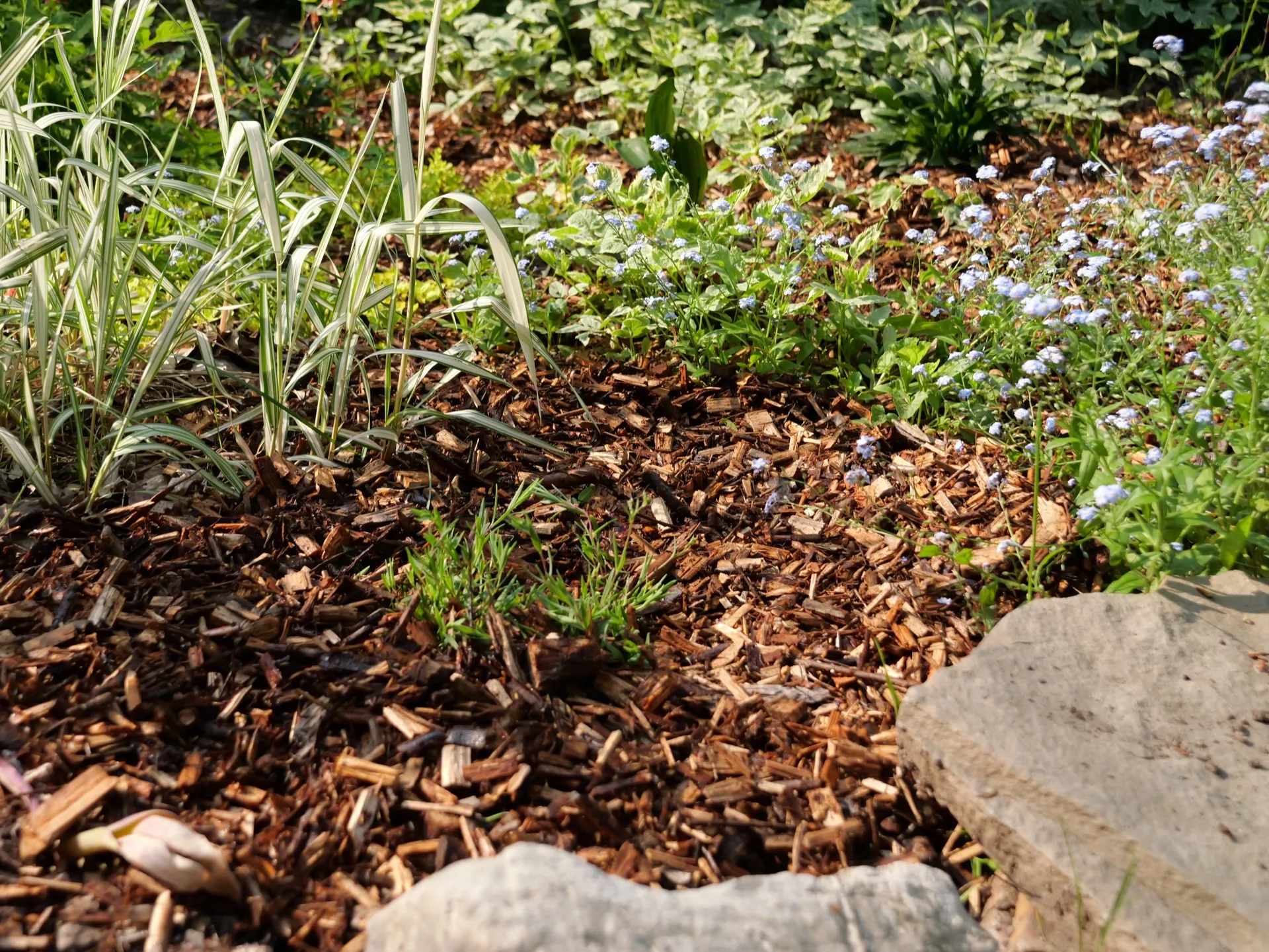
Ramial chipped wood (RCW) is the young branches of hardwood trees, under 7 cm in diameter, chipped fresh and applied to the soil. It is not sawmill mulch, compost or decorative chips: it is a biologically active material that transforms the structure, chemistry and microbial life of soils.
The concept was developed in the 1980s by Professor Gilles Lemieux of Université Laval. His observation: a forest's fertility comes from the continuous renewal of small branches and fine roots, rich in sugars and young lignin, far more than from mature dead wood1.
Why young branches
Young twigs contain a high share of bark and cambium, the living zone of the tree, lignin still accessible to decomposer fungi and sugars that immediately feed the soil microflora. Mature wood chips, dominated by heartwood, do the opposite: poor in nitrogen, they tie up available nitrogen and starve plants of it2.
How RCW acts on the soil
Applied to the surface, RCW is colonized by fungi able to break down lignin. Within months, the compounds released bind to clays to form clay-humus complexes; within years, they become a stable humus that slowly releases nutrients, water and carbon.
Unlike compost, which mineralizes in one to three years and releases its nutrients all at once, RCW builds long-term organic capital. That is what makes it so relevant for soil restoration and long-lived substrates.
Documented benefits
More than 40 years of research, notably in Quebec, have measured consistent effects.
Soil structure: adding fresh woody residues improves aggregation and structural stability, an effect still measurable nine years after application3.
Durable carbon: on degrading organic “black soils”, adding willow chips has been identified as a way to move toward carbon equilibrium4.
Water and nutrients: the humus formed holds water and releases nutrients gradually, reducing leaching. Applied as young twigs, RCW limits nitrogen draw-down, although nitrogen should be monitored in the first year2.
Disturbed sites: in a boreal mining context, RCW mulch promotes spontaneous plant succession and reforestation on waste rock5.
Why willow
RCW can come from several hardwoods, but willow has three industrial advantages. It is rapidly renewable: short-rotation cultivation, mechanized harvest, regrowth without replanting. It offers a controlled supply: Ramo's production in Saint-Roch-de-l'Achigan and La Corne, Abitibi, provides a calibrated, traceable material without the variability of urban pruning waste. And it is contaminant-free: grown for phytotechnology, it is free of pesticides and unwanted exotic species, an essential criterion for certified substrates and mulches.
Willow RCW in Ramo projects
Soil restoration: on mining sites and waste rock piles, RCW kick-starts humus formation and speeds up plant recolonization5. At Sayona's lithium complex, willows are harvested as chips and reused as an input for the site's progressive restoration.
Revegetation substrates: because it releases water and nutrients slowly, RCW suits long-lived substrates such as green roofs.
Horticultural mulch: Ramo's 100% willow RCW mulch is sold in more than 50 garden centres across Quebec. It protects the soil, limits evaporation and feeds microbial life, without the nitrogen draw-down of mature-wood mulches.
Scientific sources
- Lemieux, G. (1996). The hidden world that feeds us: the living soil. Université Laval, Groupe de coordination sur les bois raméaux.
- Beauchemin, S., et al. (1992). Évolution de l'azote dans un sol amendé par des bois raméaux fragmentés. Canadian Journal of Soil Science, 72(4), 521-535.
- N'dayegamiye, A., & Angers, D. A. (1993). Organic matter characteristics and water-stable aggregation of a sandy loam soil after 9 years of wood-residue applications. Canadian Journal of Soil Science, 73(1), 115-122.
- Dessureault-Rompré, J., Libbrecht, C., & Caron, J. (2020). Biomass crops as a soil amendment in cultivated histosols: Can we reach carbon equilibrium? Soil Science Society of America Journal, 84(2), 597-608.
- Taurines, S. (2024). Le paillis de bois raméal fragmenté comme approche de restauration écologique des roches stériles en contexte boréal. Master's thesis, Polytechnique Montréal.
Keep exploring.
Willow at the heart of Ramo solutions
Evapotranspiration, growth, carbon, roots and biodiversity.
Read →Willow cultivation, step by step
Cuttings, planting, coppicing (the cycle that produces the raw material for RCW).
Read →Nearly 70 cultivated varieties in Canada
Why Ramo grows so many willow varieties and how each one finds its place.
Read →Could your project benefit from willow RCW?
Restoration, substrates or professional mulch: our agronomic team can help size and specify the right application for your requirements.
Let's talk about your project