
Willow
at the heart of Ramo solutions.
Since 2006, Ramo has put willow to work in service of a clear mission: to solve concrete environmental challenges through vegetated solutions.
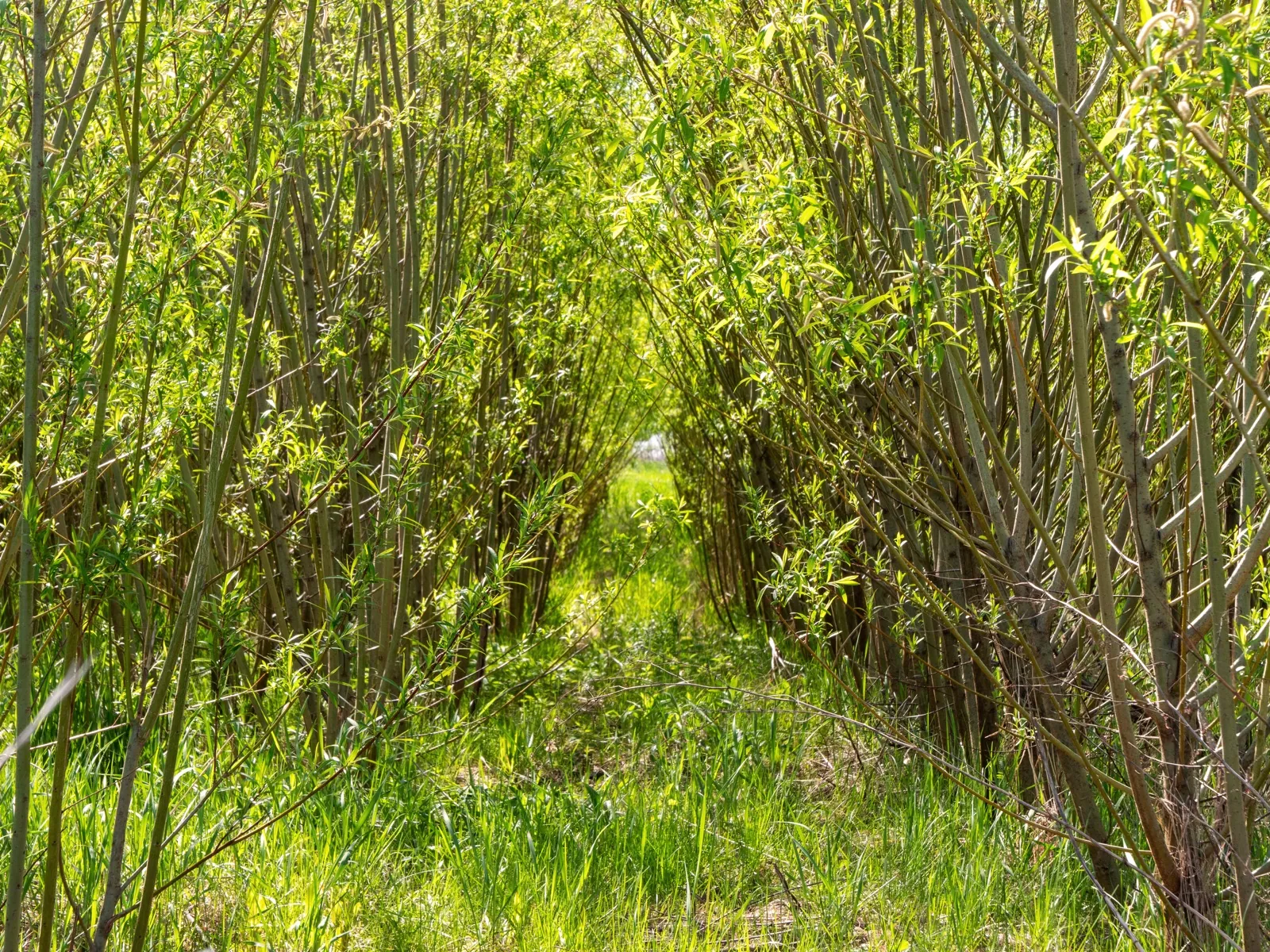
Across Quebec, millions of willows planted by Ramo restore degraded sites, reduce the volumes of water to be treated and produce renewable biomass. One species, four capabilities rarely found together: it grows fast, it drinks deeply, it regrows after cutting and it adapts to harsh environments.
Why willow?
Thousands of species can be used to restore or reforest a site. Few combine fast growth, high evapotranspiration, excellent regrowth after cutting, strong tolerance to difficult conditions and high biomass production.
That combination lets willow play several roles at once: water-management infrastructure, soil-restoration tool, renewable raw material and greening agent. For Ramo, it is the foundation of a platform of solutions deployed at scale.
Evapotranspiration: a biological pump
A review of 57 studies covering 19 willow species reports an average evapotranspiration rate of 4.6 mm per day, roughly 46 m³ of water per hectare every day1. In an optimized system the rate climbs: in a Quebec treatment wetland, the Salix miyabeana SX67 cultivar reached 22.7 mm per day2.
This is the principle behind Evaplant® and Evacap™. Evaplant® is a plantation precisely irrigated with wastewater (leachate, composting water, mining effluent, municipal water) and designed to discharge nothing off site3. Evacap™ applies the same property, passively, to stormwater on industrial sites.
The effect goes beyond the water balance. On a municipal effluent, a willow filter removed 91% of the chemical oxygen demand and nearly 98% of the phosphorus4. Our rule is simple: match irrigation to the plant's seasonal needs rather than to a constant flow.
Fast growth and a renewable resource
Willow reaches full functionality within a few seasons, where many forest species take decades. It quickly establishes a vegetated cover, stabilizes disturbed soils and raises the site's water consumption. Water availability remains the main driver of its growth.
After cutting, willow regrows from the stump. A plantation can therefore be harvested several times while keeping its root system: the biomass becomes a renewable resource rather than a one-time product.
Carbon: captured in the biomass and in the soil
Willow stores carbon in its stems, but also in its roots and in the soil. Over 23 years, North American work estimates up to 11.3 tonnes of CO₂ per acre sequestered in the root system alone5, and short-rotation plantations established on former farmland in Quebec show real potential for soil carbon storage6.
A Quebec case stands out: the organic “black soils” that support much of the province's vegetable production have been mineralizing and eroding since 1950. Applying willow chips has been identified as a way to slow that degradation while storing carbon7.
Roots that restore soils
Below the surface, a dense root network stabilizes slopes, limits erosion, improves soil structure and restarts biological activity. The need is considerable: more than 1,500 hectares of mining sites await rehabilitation in Quebec8, not counting sand pits, landfills and industrial land where conditions are hostile to vegetation.
Science confirms willow's relevance in these settings. Native species restore disturbed mining sites in eastern Canada9, willow restarts soil biological processes10 and its phytoremediation potential is documented for several contaminants11. It acts as a pioneer species that quickly re-establishes a functional cover.
Biodiversity: a living cover
Willow is one of the first plants to bloom in spring. Its catkins offer pollen and nectar to pollinators when resources are scarce. In a plantation of 30 cultivars, one study recorded 57 species of wild bees, several of them rare or declining12, and Canadian work confirms this role for the pollinators of fruit crops13.
Plantations also shelter insects, birds and small mammals. On a degraded site, their establishment often marks the start of a transition toward a more diverse habitat. Where objectives allow, Ramo combines willows with other species to accelerate that succession.
In the right place, with the right design
Willow is not the answer to every environmental challenge. But used in the right place, with the right design and the right monitoring, it becomes a natural infrastructure able to restore sites, manage water and produce renewable resources at scale.
Scientific sources
- Frédette, C., et al. (2019). Willows for environmental projects: A literature review of results on evapotranspiration rate and its driving factors across the genus Salix. Journal of Environmental Management.
- Frédette, C., Grebenshchykova, Z., Comeau, Y., & Brisson, J. (2019). Evapotranspiration of a willow cultivar (Salix miyabeana SX67) grown in a full-scale treatment wetland. Ecological Engineering, 127, 254-262.
- Frédette, C., Barbeau, L.-C., Lachapelle-Trouillard, X., Comeau, Y., Pitre, F., & Labrecque, M. Landfill leachate treatment with willow short-rotation coppice plantations: towards more universal design criteria based on plant-soil water dynamic.
- Lachapelle-T., X., Labrecque, M., & Comeau, Y. (2019). Treatment and valorization of a primary municipal wastewater by a short rotation willow coppice vegetation filter. Ecological Engineering, 130, 32-44.
- Yang, S., Volk, T. A., & Fortier, M.-O. P. (2020). Willow Biomass Crops Are a Carbon Negative or Low-Carbon Feedstock. Energies, 13(16), 4251.
- Lockwell, J., Guidi, W., & Labrecque, M. (2012). Soil carbon sequestration potential of willows in short-rotation coppice established on abandoned farm lands. Plant and Soil, 360(1), 299-318.
- Dessureault-Rompré, J., Libbrecht, C., & Caron, J. (2020). Biomass crops as a soil amendment in cultivated histosols. Soil Science Society of America Journal, 84(2), 597-608.
- Ministère de l'Énergie et des Ressources naturelles du Québec (2020). Liste des sites miniers abandonnés.
- Mosseler, A., Major, J. E., & Labrecque, M. (2014). Growth and survival of seven native willow species on highly disturbed coal mine sites in eastern Canada. Canadian Journal of Forest Research, 44(4), 340-349.
- Sylvain, Z. A., & Mosseler, A. (2017). Use of shrub willows (Salix spp.) to develop soil communities during coal mine restoration. Canadian Journal of Forest Research, 47(12), 1687-1694.
- Yanitch, A., Kadri, H., Frenette-Dussault, C., Joly, S., Pitre, F. E., & Labrecque, M. (2020). A four-year phytoremediation trial to decontaminate soil polluted by wood preservatives. International Journal of Phytoremediation, 22(14), 1505-1514.
- Tumminello, G., Volk, T. A., & Heavey, J. P. (2017). Pollinator Benefits, Shrub Willow Fact Sheet Series. SUNY-ESF.
- Ostaff, D., Mosseler, A., Johns, R., Javorek, S., Klymko, J., & Ascher, J. (2015). Willows (Salix spp.) as Pollen and Nectar Sources for Sustaining Fruit and Berry Pollinating Insects. Canadian Journal of Plant Science.
Continue exploring.
Nearly 70 cultivated varieties in Canada
Why Ramo grows so many species and how each one finds its place.
Read →Willow cultivation, step by step
Cuttings, planting, coppicing and harvesting: the full cycle of a Ramo planting.
Read →RCW: regenerating depleted soil
Ramial chipped wood for soil restoration, substrates and professional mulch.
Read →A project where willow can make the difference?
Our team supports you from design through commissioning.
Contact us