
Willow cultivation,
step by step.
From cutting to harvest, a willow planting is a living system that is planned, established, coppiced, harvested, and regenerated. Here is how Ramo turns a dormant stem into an environmental solution, whether for an Evaplant® system, a riparian buffer, or ramial chipped wood production.
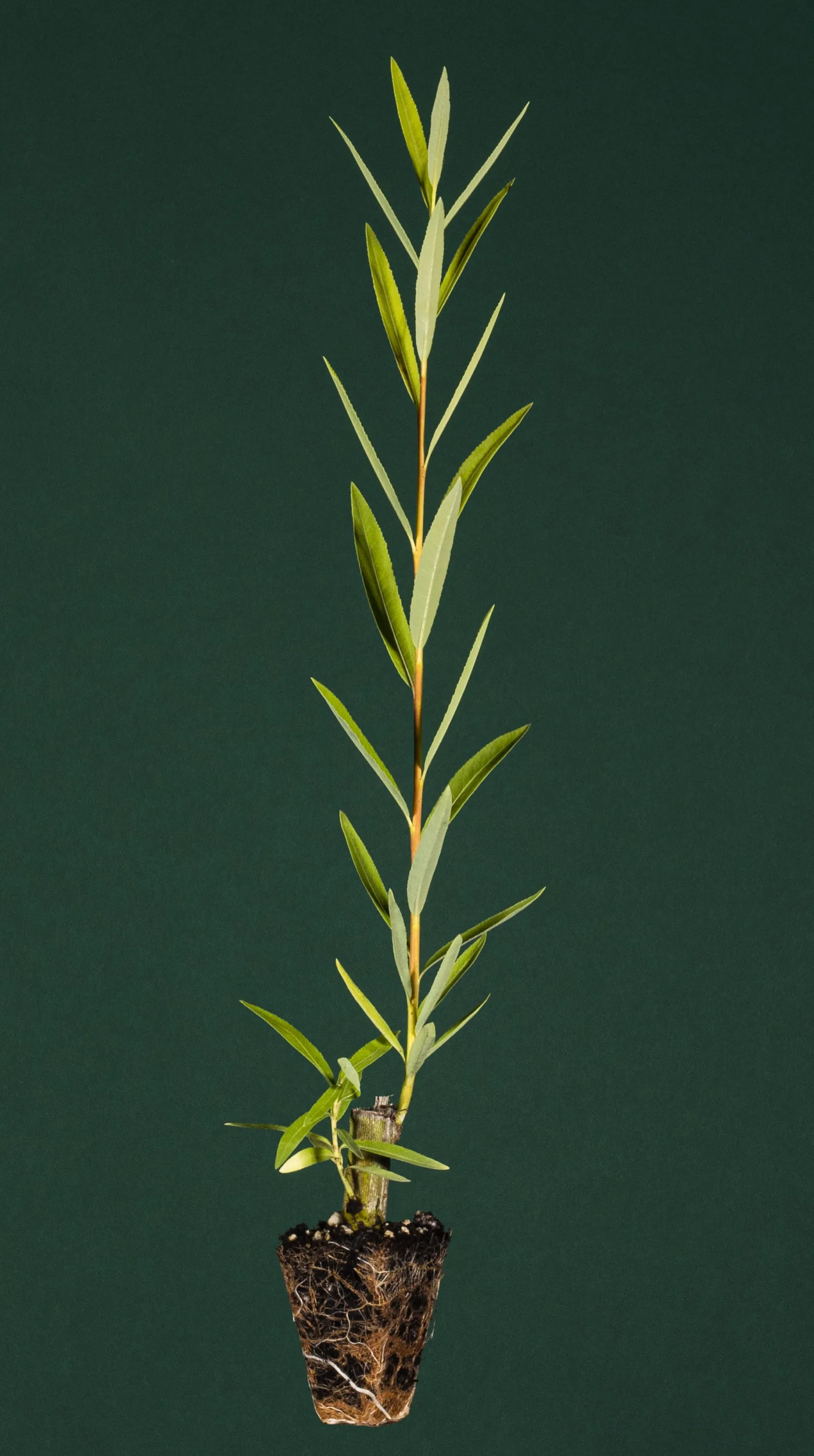
It all starts with a cutting
Willow propagates easily from cuttings: a section of stem taken from a dormant plant, which grows roots and new stems once planted1. Our nurseries produce around 30 million of them a year, enough to supply an Evaplant® plantation of 15,000 to 20,000 willows per hectare as readily as a fence or a stabilization project.
Step 1: select the variety
We choose what to plant according to the site and the objective: evapotranspiration for Evaplant® or Evacap™, biomass for RCW, stabilization of a bank, screening for a fence. Because yields vary widely with cultivar and conditions2, selection is a technical step, not a preference. When biodiversity is an objective, we also favour male willows, which offer pollinators both pollen and nectar3.
Step 2: prepare the site
Soil characterization, control of competing vegetation, tillage, amendment where needed, access and regulatory constraints1. In an Evaplant® or Evacap™ project, we add the hydraulic design and instrumentation that allow precision irrigation, with no runoff or deep percolation. Placement matters too: some species stabilize slopes but decline if their roots stay submerged4.
Step 3: plant
Cuttings are planted at high density, in a pattern suited to the objective, and planting can be mechanized for large areas1. Depth, soil contact, moisture and weed control determine establishment in the first year.
Step 4: coppice
At the end of the first season, stems are cut close to the ground. This cut stimulates regrowth, multiplies stems and builds vigour: stumps and roots stay in place and send up new shoots1. This is the mechanism that avoids replanting every cycle.
Step 5: growth and monitoring
Stems gain height, the canopy closes, water consumption rises. In an Evaplant® system, this is when the infrastructure ramps up to full performance. Monitoring covers survival, growth, plant health, soil moisture and, for irrigated systems, the volumes applied.
Step 6: harvest, then regrow without replanting
Harvest typically returns every two or three years, and the system stays productive for 25 to 30 years. After cutting, the stump regrows: roots stay in place and keep stabilizing and enlivening the soil between harvests. Where biodiversity matters, the cycle is spread across several plots so that some willows bloom every spring3.
Step 7: put the biomass to use
At Ramo, biomass is a raw material. Depending on stem age and diameter, it becomes ramial chipped wood, mulch sold in more than 50 garden centres across Quebec, Pilebyg noise barriers, fences, bundles or plants. This is the loop that links willow cultivation to our entire product range.
An agricultural crop working for the environment
Willow cultivation is a hybrid system: agricultural in its management, forestry-like in its biomass, environmental in its functions. Well designed, a plantation produces, restores, filters, stabilizes, evapotranspires, captures carbon and supports biodiversity. That is the foundation Ramo turns into solutions, from nursery to finished product.
Scientific sources
- Labrecque, M., & Lajeunesse, S.-L. (2017). Guide de production de saules en culture intensive sur courtes rotations.
- Lafleur, B., Lalonde, O., & Labrecque, M. (2016). First-Rotation Performance of Five Short-Rotation Willow Cultivars on Different Soil Types and Along a Large Climate Gradient.
- Tumminello, G., Volk, T. A., & Heavey, J. P. (2017). Pollinator Benefits, Shrub Willow Fact Sheet Series. SUNY-ESF.
- Habitat-Nature (2022). Fiches techniques : limiter l'érosion et la pollution agricole en restaurant des coulées agricoles. Fiducie écosystèmes Lanaudière. www.habitat-nature.com
Continue exploring.
Willow at the heart of Ramo solutions
Evapotranspiration, growth, carbon, roots, and biodiversity.
Read →Nearly 70 cultivated varieties in Canada
Why Ramo grows so many varieties and how each one finds its place.
Read →RCW: regenerating depleted soil
Ramial chipped wood for soil restoration, substrates, and professional mulch.
Read →Planning a large-scale planting project?
Our agronomic team supports you from planning to coppicing, with 20 years of field expertise.
Tell us about your project