
Thousands of willows take root in Neuville: an innovation that protects water, biodiversity, and municipal budgets
The Portneuf regional residual materials authority has just planted 96,000 willows at the Neuville Environmental Complex to absorb and evaporate part of the leachate. Nearly one million fewer litres released into the environment each year.
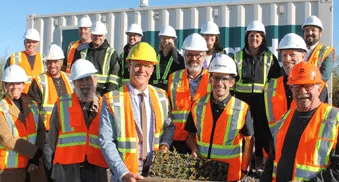
Neuville, September 30, 2025. What if trees could help improve water quality, protect biodiversity, and ease pressure on our municipal public finances? That is the bet made by Portneuf's regional residual materials authority (RRGMRP), which has just planted 96,000 willows, the equivalent of a small forest covering 10 football fields, at the Neuville Environmental Complex. Their role: absorb and evaporate part of the contaminated water produced by buried waste, known as leachate. The expected result is nearly one million fewer litres of water discharged into the environment each year.
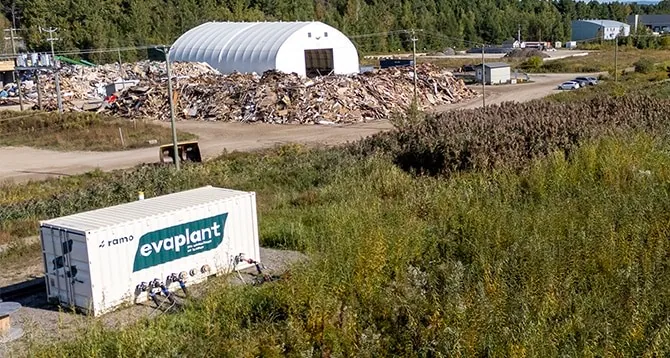
This new approach, called Evaplant®, was designed by Ramo, a Quebec environmental innovation company based in Saint-Roch-de-l'Achigan. It relies on a fully automated precision-irrigation system that sends leachate to the willows. These fast-growing trees absorb water and naturally release it into the air through evapotranspiration, while also helping capture certain contaminants in their biomass. By combining nature and technology, the authority reduces pressure on a treatment plant already close to capacity and improves its environmental performance in a concrete way.
Four major benefits for the Neuville community and the Portneuf MRC
Preserved infrastructure
By reducing the volume of wastewater that must be treated, the willow planting reduces pressure on the environmental complex's infrastructure, especially its treatment plant, which is already nearly at capacity. This can help defer future investments.
"This project allows us to manage our resources and facilities intelligently while improving our environmental performance."
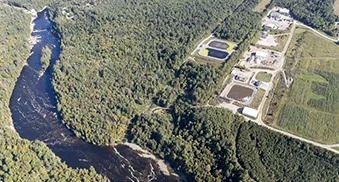
A healthier Jacques-Cartier River
Every litre evaporated by the willows is one less litre reaching the river. Less contaminated water to treat is a direct gain for ecosystem health and for sensitive species such as salmon.
Better management of emerging pollutants
Certain persistent contaminants, such as PFAS, sometimes called forever chemicals, are difficult to treat and are of growing concern to scientists. A research team from the Institut de recherche en biologie végétale (IRBV) is closely monitoring the ability of willows to retain these substances.
"Fast-growing willows, because of their exceptional evapotranspiration capacity, show very interesting potential for retaining certain emerging contaminants such as PFAS. This project allows us to study plant responses to these contaminants and contribute to the development of an integrated management approach for these substances based on green technology."
Captured carbon and organic matter produced
In addition to their filtering role, willows capture carbon and produce biomass. That biomass is then transformed into useful organic matter for operations at the Neuville Environmental Complex.
A nature-based solution
Beyond its technical benefits, the project shows how apparently simple solutions can address complex environmental challenges and generate tangible benefits for communities.
"In addition to capturing carbon and greening environments, trees can also help solve complex environmental challenges. We are proud to support a nature-based solution that concretely improves water quality."
"The authority chose to act proactively on an emerging issue affecting many landfill sites across the country: PFAS management in leachate. Evaplant® shows how nature-based technology can support that work by reducing volumes to be treated and helping limit the dispersion of these contaminants. The Neuville project opens the way to an inspiring approach for other Quebec municipalities."
The project benefited from financial support from Tree Canada. The facilities can be visited by appointment at the regional authority's Environmental Complex in Neuville.

Have a question?
Contact us.
Our team is available to discuss your needs and recommend the right solution.